
- This event has passed.
Fall 2025 GRASP on Robotics: Neville Hogan, Massachusetts Institute of Technology, “Sensory-motor control in humans and robots”
November 7 @ 10:30 am - 11:45 am
This event was in-person ONLY in Wu and Chen Auditorium.
ABSTRACT
Despite recent advances, humans are still more agile and dexterous than robots; yet human communication (nerves) and actuation (muscles) are slower and our musculo-skeletal system is more complex. This presentation will consider features of neuro-mechanics that may confer advantage. However, they also impose limitations.
Muscle is highly ‘back-drivable’, enabling our ease with (even preference for) ‘contact rich’ tasks. However, muscle is not just a force-generator. Our endo-skeleton requires muscle stiffness for stability; moreover, stiffness must increase at least in proportion to tension.
Consequently, human strength is not limited by force production but by stiffness production. Recent experiments confirm this.
Measuring stiffness (or its dynamic generalization, mechanical impedance) requires access to three variables, but only two are directly measurable: force and position. ‘Subtracting’ a model of limb mechanical impedance enabled estimating the neurally-defined reference trajectory (the third variable) underlying a simple ‘contact-rich’ task: turning a circular crank. It displayed a coincidence of curvature maxima and speed minima, despite the strictly-constant curvature of the constrained hand path. This feature, as well as an observed dependence on turning direction, was reproduced by a model composing the neurally-defined reference trajectory from superimposed oscillations.
Composing cyclic movements from ‘primitive’ oscillations simplifies control but implies a speed-curvature constraint that is widely reported; it significantly limits human performance. It also accounts for our remarkable inability to control force exerted on a moving robot.
The composability of motion is complemented by the composability of mechanical impedance. That enables a truly modular approach to robot programming. It simplifies transitions between free and constrained motion; manages redundancy without inverse kinematic computations; and enables operation into, at, and out of singular configurations—all features of human sensory-motor control that may benefit robots.
Presenter
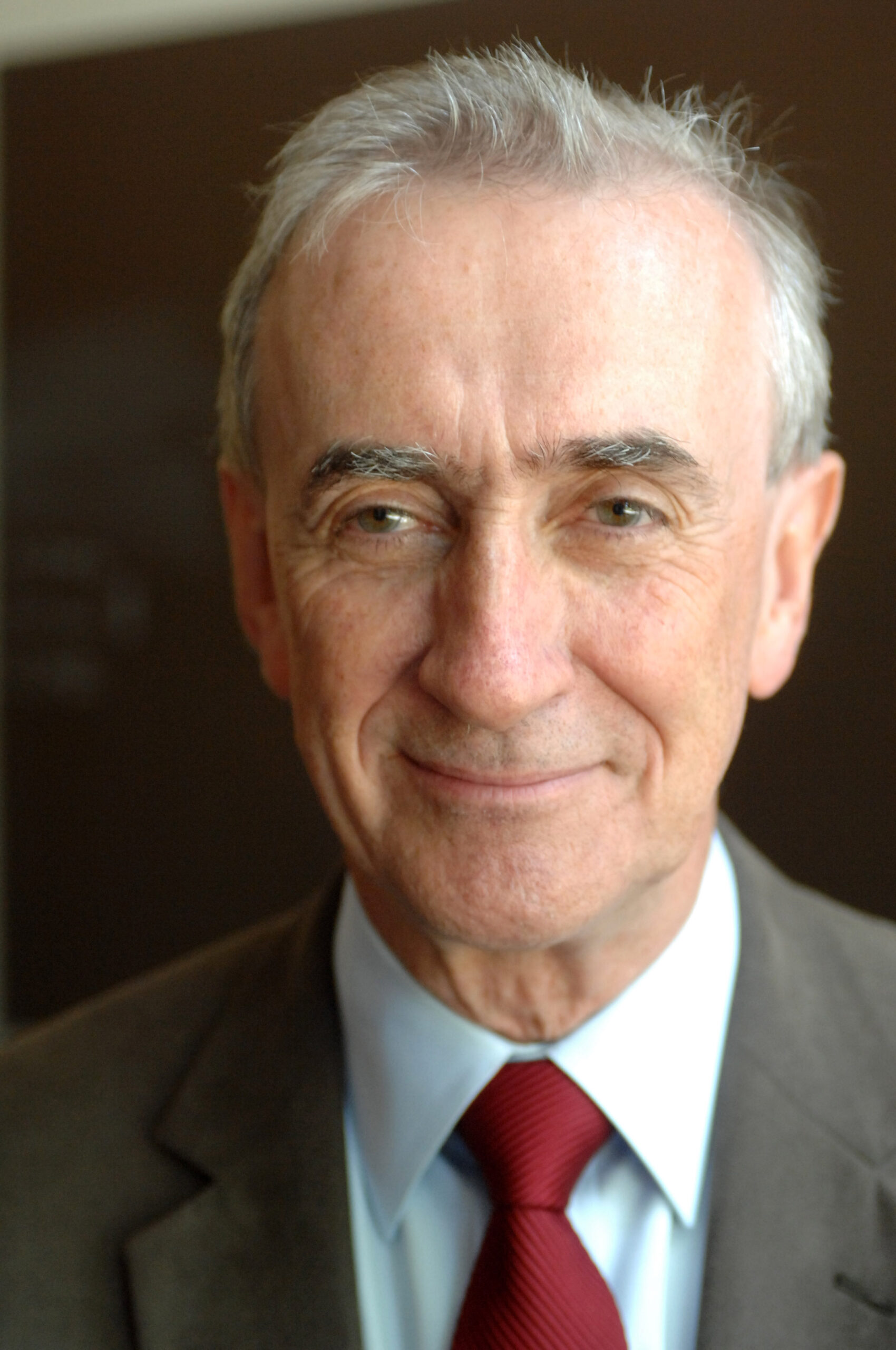
Neville Hogan - Learn More
Neville Hogan is Sun Jae Professor of Mechanical Engineering and Professor of Brain and Cognitive Sciences at the Massachusetts Institute of Technology. He earned a Diploma in Engineering (with distinction) from Dublin Institute of Technology and M.S., Mechanical Engineer and Ph.D. degrees from MIT. He joined MIT’s faculty in 1979 and presently directs the Newman Laboratory for Biomechanics and Human Rehabilitation. He co-founded Interactive Motion Technologies, subsequently part of Bionik Laboratories. His research includes robotics, motor neuroscience, and rehabilitation engineering, emphasizing the control of physical contact and dynamic interaction. Awards include: Honorary Doctorates from Delft University of Technology and Dublin Institute of Technology; the Silver Medal of the Royal Academy of Medicine in Ireland; the Saint Patrick’s Day Medal for Academia from Science Foundation Ireland; the Henry M. Paynter Outstanding Investigator Award and the Rufus T. Oldenburger Medal from the American Society of Mechanical Engineers, Dynamic Systems and Control Division; and from the Institute of Electrical and Electronics Engineers, the Academic Career Achievement Award from the Engineering in Medicine and Biology Society and the Pioneer in Robotics Award from the Robotics and Automation Society.